

Before the Shooting

The Columbine mass shooting of 1999 shocked us into an unfathomable nightmare. We didn’t know it wasn’t a one-off. Instead, it was a playbook ushering in a new era of horrific repetitions that continue to this day.
Every one of these atrocities is punctuated with the question why. The only answer I could imagine was: A mind had lost its grip. I tried to express it in this poem, written several years ago.
The Gray Horizon

The enormous importance of his insignificance
settled upon him like acid fog
and etched a former clarity into
obscure, dismembered thought.

His disintegrating mind once understood
about good. Now, the unthinkables
were becoming less so. Still aware enough
to know he should hide the guns.

Poor soul. If it had been any
sickness you could see,
he might have evoked sympathy.
Instead, he needed notoriety.

He was a stretched elastic band
twanging warnings into heads, spinning
in bewilderment. So overwhelmed with self,
he couldn’t take the off-ramps.
I thought of Charles Julius Guiteau, the man who shot president Garfield in 1881 because he felt disregarded, dismissed, belittled. And Mark David Chapman, the man who killed John Lennon almost 100 years later, 1980, for, as he claims, religious reasons. It seems incongruous that his Christian values allowed him to commit murder. But it has happened throughout history so, it’s not unfamiliar. Then the hell of all the mass shootings we’ve lived through since. Jon Stewart expresses our frustration and fury in this clip from June 2025.
Why do these killers exist and proliferate?
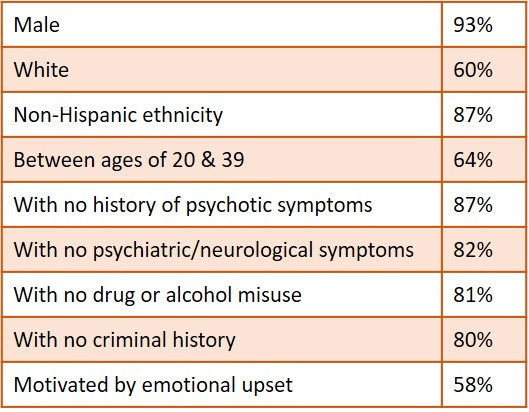
First, some stats quoted from this study published on the National Institutes of Health website.
The majority of perpetrators are:
Some Thoughts From Researchers
Mental Illness
As you can see from this table and the study itself, it says that mental illness doesn’t appear to be much of a factor:
“Findings suggested that mental illness may, in many cases, be incidental to the motivations for the murders. In addition to an overemphasis on severe psychopathology among those who carry out such acts, the specific triggers that precipitate mass murder have been stereotyped in the public eye. It is commonly believed, for instance, that mass murders are often triggered by bullying; work- or school-related grievances; a desire for attention; or in the context of poor social connections.”
I’m not convinced. Are the triggers really being stereotyped or are they part of the root problem? Do I need to throw that poem away? Not just yet.
From Ragy Girgis, MD, (who is cited as one of the contributors to the above article), at Columbia Psychiatry.org, we are informed:
“First, understand that mental illness as the primary cause of any mass murder, especially mass shooting, is uncommon. [Oh boy, it’s not looking good for the poem. I’m honing my aim for the trash basket.] Half of all mass shootings are associated with no red flags—no diagnosed mental illness, no substance use, no history of criminality, nothing.”
How many people can have mental illness without being diagnosed? And how many people admit to substance use?
But here is something Dr. Girgis and I agree on:
“…the mass shooters that we hear the most about, such as school shooters and other individuals who commit such public crimes, we have examined a number of these cases and are seeing a pattern. As opposed to most mass shooters, these perpetrators tend to be younger males who are often nihilistic, empty, angry, feel rejected by society, blame society for their rejection, and harbor a strong desire for notoriety. They want to make their mark on the world that will elevate them to the status they believe they are entitled to and deserve.”
Which leads us to:
Grievance & Rage
Near the beginning of this article, the table of stats provided on the NIH website claims that most mass shootings are done by young, white, non-Hispanic males. Why? What are the motivating factors for that distinction?
Loss of superior or favored status. They don’t feel special when programs exist that encourage and support minority groups. They feel pushed aside and disrespected when non-whites, immigrants, LGBTQ+, and other minorities are given special consideration. There’s a shared feeling that it’s hard enough to navigate this world without having to compete in a system that they feel disadvantages them.
Economic insecurity. There was a time when a family could exist comfortably on one 4-figure income. Unbelievable, right? Now it takes that and more per month for a single person to live day-to-day and with little hope of ever owning a home. Our subject men on a hamster wheel of work (when they can even get a job), feel resentful that society has failed them, taken away their opportunity for the basic lifestyle their parents’ generation had.
Politics. Feeding the sense of injustice that the subject men feel is an effective way to encourage right-wing political thinking. The word “again” in the MAGA slogan is critical. It’s a way of saying, “Hey, things got out of whack and you are the victims. We’re gonna make it like it used to be where you got ‘a chicken in every pot’.” That’s provocative enticement for those seeking a way out of their anger and despair. And the politicians, instead of blaming failed policies and the disastrous wealth gap they created, can blame the beneficiaries of those programs mentioned in point one above. There’s nothing like a common enemy to redirect attention from the authors of the problem.
Social Media
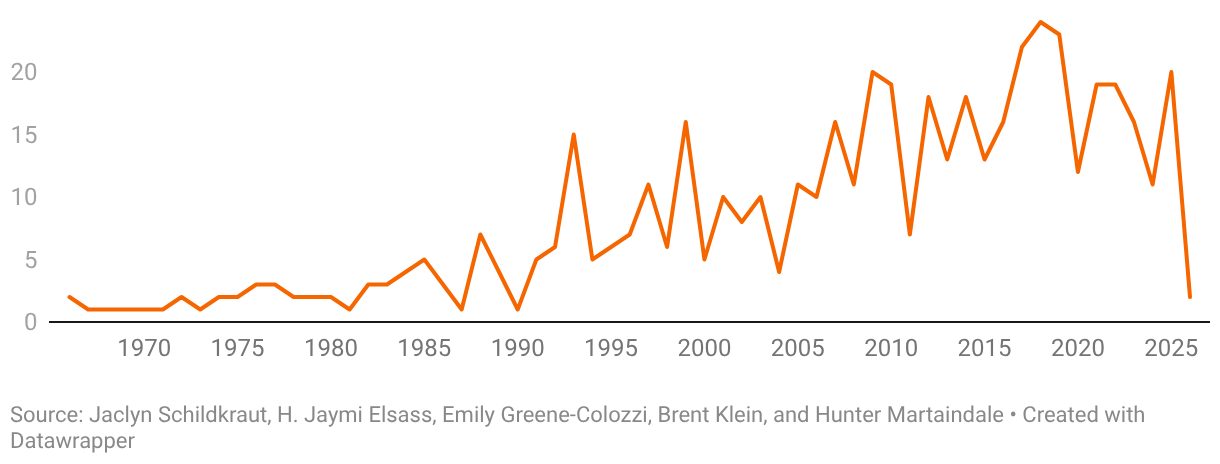
Does social media compound the problem? This graph from the Rockefeller Institute of Government shows us how mass shootings have increased since the internet became prevalent in our lives, around 1993. An interactive version showing actual numbers is available here.
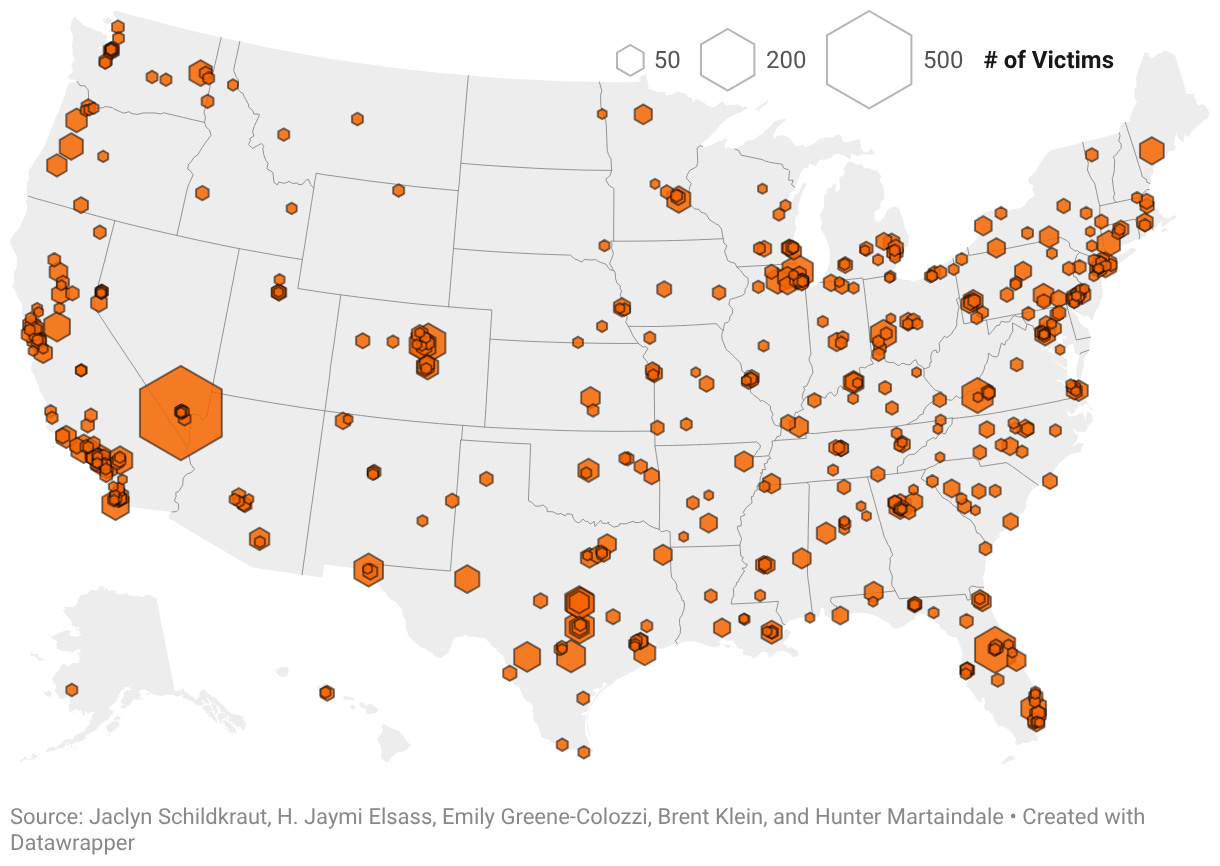
This map shows the place, date and casualty count of mass shootings from 1966 on, which you can access by clicking on the hexagons on the interactive version on the Rockefeller Institute’s page.
If an enraged person is seeking fame along with retribution, what better avenue than instant everything through social media? It’s the place where it’s possible to receive glorification for heinous acts of cruelty. Sounds like an ideal home for a perpetrator to find understanding, sympathy, and encouragement. This is so desperately depressing, there’s little wonder at the increasing interest in Forest Bathing.
Violent Video Games
Do violent video games desensitize us and glorify killing?
The majority of experts say no. But the question was rendered moot by the Supreme Court in 2011 when it said we can’t prohibit those games because that would be a violation of free speech.
There is an article by Distinguished Professor Arie Kruglanski in The Conversation who writes an opinion that masters the moment. It’s recommended reading to get some clarity on the subject. (Thank you, Creative Commons, for making this freely available for sharing.)
Here are several salient points plucked from his insightful article.
“Each shooter’s life story is unique, yet the growing number of mass shootings suggests a general trend that transcends personal details.
“…the general motive that drives mass shootings is a fundamental human need. It is everyone’s quest for significance and a feeling that their life matters.
“That need gets activated when someone feels the loss of significance, the sense of being slighted, humiliated or excluded, but also when there is an opportunity for a gain in one’s sense of significance, being the object of admiration, a hero or a martyr in other people’s eyes.
“The shocked public attention a shooting attracts delivers instantaneous “significance.”
“In today’s fractured public sphere dominated by social media, it is easy to find networks of supporters and admirers for nearly anything under the sun, including the most repugnant and unconscionable acts of cruelty and callousness.
“What my colleagues and I call the “Three Ns”: need, narrative and network, refer to the would-be shooter’s need to become significant or notorious, the narrative that says being a shooter means being important, and the network that exists to support such behavior [all emphasis mine]. They together combine into a toxic mixture, driving a person to carry out a mass shooting.”
How about his suggestion for a path to reduce the number of incidents?
“It is equally important to identify and make available alternative paths to significance, conveyed in alternative narratives. This would likely require a concerted effort across society and its institutions. Understanding the psychology of it all may be a necessary precondition for taking effective steps in this direction.”
I think the word likely should be removed. And after all the years of these mass shootings, how likely is it that the “concerted effort across society and its institutions” will ever appear on the horizon? Forest Bathing, anyone?
And, oh yes. I think Dr. Kruglanski saved my poem from the trash basket.

On a topic so hot and plagued with differing, sometimes strident, opinions, there is no way to put a tidy bow on a pronouncement of “here’s your answer.” After all, humans are involved and that usually means complications. But here’s a visual of the foregoing that at least ties together the suggested causes.
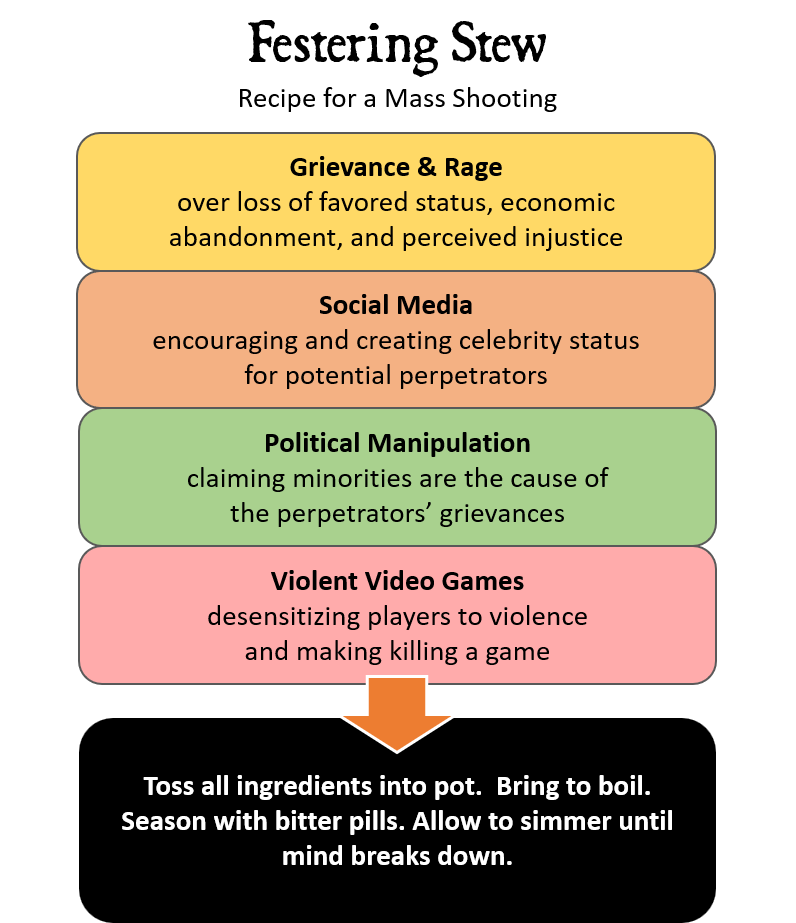
No tidy bow. But in trying to understand the why in order to stop the when of these mass shootings, it is a fact that there is one ingredient common to every one of them. Guns.
I leave this with a parting question.
“In a 2014 review of 160 active shooter incidents in the U.S. from 2000 to 2013 across 40 states and the District of Columbia, the FBI found that the perpetrator was female in only 6 of the 160 incidents (4%)” Wikipedia
Why is that? Again, in the murky domain of humanness, research gives us suggestions, but no concrete answers. Some possibilities offered are:
Biology – males have more testosterone and are therefore more aggressive than females.
Mental Health Care – it’s culturally more acceptable for females to get help with mental health issues.
Pressure – males are encouraged to exhibit dominant and intimidating behavior
Objectification – the constantly minimized, pervasive assaults – both physical and sexual – against females gives them a visceral understanding of the horrors of violence and an empathy for the victims that male mass shooters seem incapable of comprehending or caring about.
And here’s another one to throw into the mix. Unlike males, females can’t lament losing the favored status they never had in the first place.

This is such an important and well-written article. Despite all the arguments against it, the very presence of the gun makes this a problem. With the solution staring us in the face.